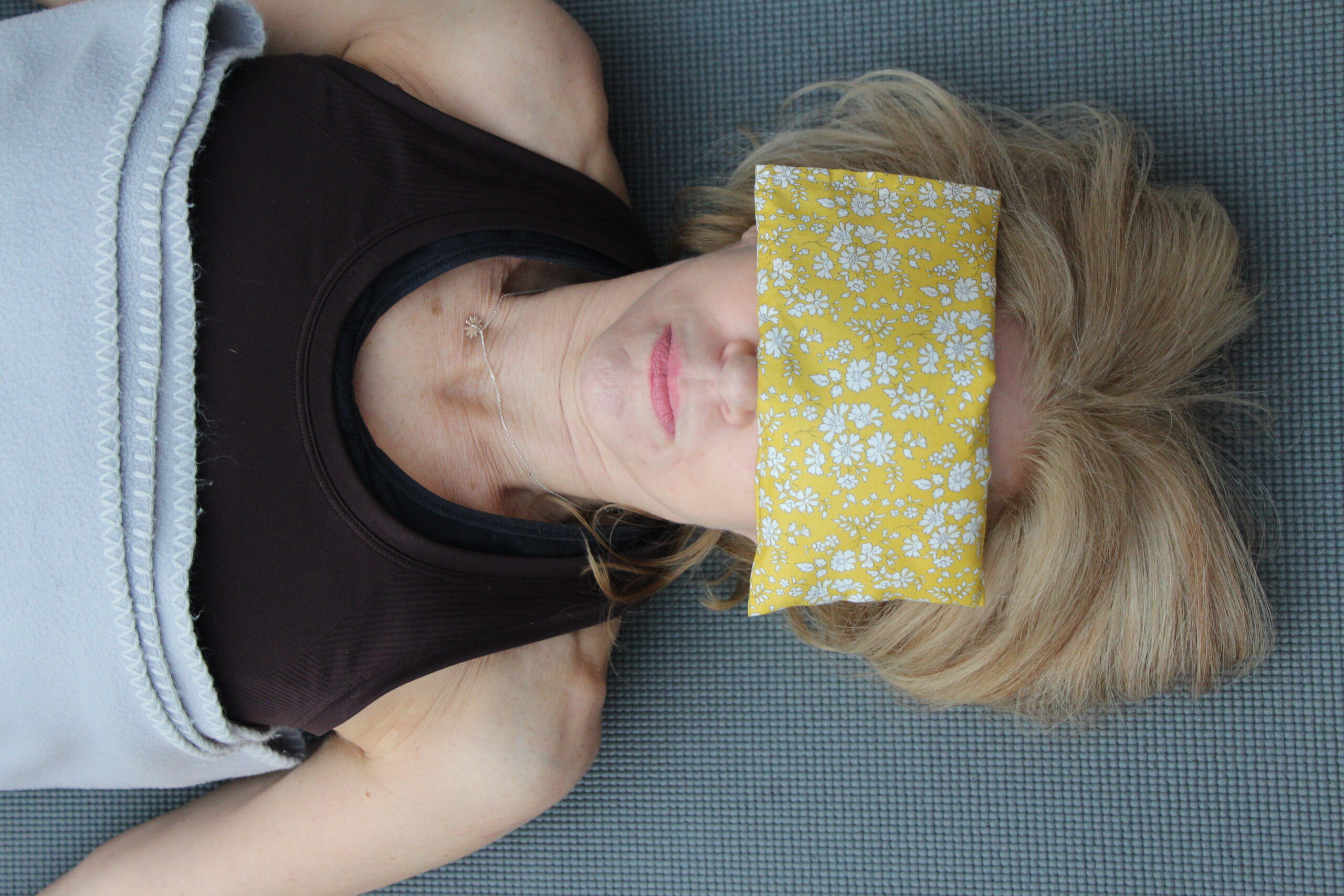
At a recent festival, I spent a great deal of time talking about eye pillows. What surprised me most was how many people had never used one—or assumed that an eye pillow was simply another name for a sleep mask.
It isn’t.
A weighted eye pillow is a wonderfully simple wellbeing tool: a small fabric pillow, usually filled with seeds or grains, that rests gently across the closed eyes and surrounding facial area. Its purpose is not to fasten around your head or remain in place while you move. It invites you to lie down, become still and take a deliberate pause.
And sometimes, that small invitation is exactly what we need.
From the yoga mat into everyday life
Eye pillows are closely associated with modern yoga, meditation and restorative practices. They are most commonly used during “Savasana”, or Corpse Pose, the final resting position at the end of a yoga class.
After moving through a strong or energetic practice, perhaps including flowing sequences, standing postures or the more physically demanding traditions of Ashtanga yoga, Savasana gives the body time to settle. You lie comfortably on your back, allow the muscles to soften and give the effects of the practice an opportunity to integrate.
Placing an eye pillow over the closed eyes can deepen this transition from movement into stillness. By blocking out the light and reducing visual distraction, it creates a darker, quieter little world in which there is temporarily nothing to look at, respond to or achieve.
Although eye pillows are now strongly connected with yoga culture, it would be difficult to claim that the modern filled eye pillow itself is an ancient yogic object. It is better understood as a contemporary wellbeing prop inspired by the longstanding traditions of yoga, meditation, sensory withdrawal and conscious rest.
Thankfully, you do not have to practise yoga to benefit from using one.
Why does gentle weight feel so comforting?
The face holds more tension than many of us realise. We furrow the brow, narrow the eyes, clench the jaw and concentrate on screens for hours at a time!!! Often without even realising.
When a soft, weighted eye pillow settles across the brow, eyelids and surrounding eye area, its gentle pressure can encourage these small facial muscles to soften. At the same time, blocking out light reduces visual stimulation and gives the eyes permission to stop working for a while.
There may also be a fascinating physiological reason why pressure around the eyes can feel so calming.
Here’s an interesting bit of science: The oculocardiac reflex, or OCR, is a recognised connection between the eye area and the cardiovascular system. It is also known as the trigeminovagal reflex because sensory information travels through the trigeminal nerve and produces a response through the vagus nerve.
The vagus nerve forms an important part of the parasympathetic nervous system, the branch associated with rest, recovery and the body’s return to a calmer state. When the OCR is triggered, vagal activity can cause the heart rate to slow. The reflex is well documented in ophthalmology, particularly in response to pressure on the eye or movement of the muscles surrounding it.
Some wellbeing practitioners therefore suggest that the light, evenly distributed pressure of a weighted eye pillow may gently engage this eye-to-vagus pathway and contribute to the sense of relaxation many people experience.
It is important, however, to keep this claim in perspective. Most scientific research into the OCR involves much stronger stimulation during eye examinations, surgery or medical procedures.
What we can say is that an eye pillow brings together several elements that support relaxation: darkness, stillness, reduced sensory input, comforting weight and an opportunity to breathe more slowly. Together, these may help the body move away from a state of constant alertness and towards the quieter “rest and restore” side of the nervous system.
You may notice your breathing becoming steadier, your heart rate slowing down, your shoulders dropping or the thoughts in your mind beginning to quieten. The pillow is not forcing the body to relax; it is creating the conditions that make relaxation easier.
An eye pillow is not an eye mask
The two are easily confused, but they have different purposes.
A sleep mask is normally lightweight and secured around the head with elastic or a strap. It is designed primarily to block out light while travelling or sleeping, and it moves with you when you change position.
A weighted eye pillow is intended for conscious rest. It is not strapped to the face. It simply rests across the eyes while you lie still, which allows the filling to mould gently to the contours of the brow, temples and cheeks.
Because it is weighted, an eye pillow often feels more grounding than a conventional sleep mask. It signals that this is not simply about making the room darker, it is about pausing.
You might use one:
- during Savasana after yoga;
- while meditating or listening to Yoga Nidra;
- before bedtime as part of an evening ritual
- while resting during a busy or overstimulating day
- or whenever your eyes feel tired from screens and concentration.
Why the filling matters
An eye pillow sits directly against one of the most delicate areas of the body, so its materials deserve careful consideration.
Natural, breathable fabrics feel pleasant against the skin and avoid the plasticky sensation of some synthetic products. A removable, washable outer cover is also useful, particularly if the pillow is used regularly.
The inner filling determines the weight, movement, temperature and overall feel of the pillow. Eye pillows may be filled with rice, synthetic beads, dried pulses or various seeds. My own preferred filling is “organic golden linseed”, also known as flaxseed.
Linseed is small and smooth, allowing it to move freely and settle gently around the contours of the face. It provides weight without feeling rigid or lumpy and has the added advantage of retaining both warmth and coolness.
Choosing organic filling and natural textiles is also a thoughtful consideration when an item will be placed so close to the eyes, nose and skin. Our own eye pillows, for example, are made using carefully chosen sustainable fabrics, organic golden linseed and removable organic wool felt strips for optional aromatherapy.
Cooling an eye pillow for hot or tired days
One of the loveliest ways to use a linseed eye pillow is to cool it.
Place the eye pillow somewhere clean and dry in the fridge for approximately 10 to 15 minutes. It should feel pleasantly cool rather than extremely cold. Then lie down, close your eyes and allow it to rest lightly across the eye area.
This can feel wonderfully refreshing during warm weather, after a long day looking at screens or whenever the head and eyes feel hot, tired or heavy.
A cool compress is also commonly recommended to help ease some of the discomfort associated with allergic or hay-fever eyes, including itching and eyelid swelling. It will not treat the underlying allergy, but it may provide temporary soothing relief.
Always keep your eye pillow dry and clean, and do not freeze it solid. If you have persistent eye pain, changes in vision, significant swelling, an eye condition, recent eye surgery or any uncertainty about applying pressure or temperature around the eyes, seek advice from an appropriate healthcare professional.
What about warming it?
Some natural-fill eye pillows can also be warmed very gently, although the care instructions supplied with the individual pillow should always be followed.
Gentle warmth may feel comforting across the forehead or while resting, particularly during colder months. However, the pillow should never be hot, and heating products containing seeds or grains requires care because overheating can damage the filling or create a fire risk.
When in doubt, use the eye pillow at room temperature. Its darkness, softness and natural weight are often all that is required.
Aromatherapy… or beautifully unscented
Some people enjoy an eye pillow filled with lavender or other dried botanicals. Others find permanent fragrance overwhelming, particularly during headaches, migraines, pregnancy or periods of greater sensory sensitivity.
A removable aromatherapy element offers more choice. A drop or two of a suitable essential oil can be placed on a separate insert rather than directly onto the pillow or filling. This allows you to change the aroma, control its strength or use the pillow completely unscented.
A little ritual of doing nothing
Perhaps the real power of an eye pillow lies not in a dramatic health promise, but in its simplicity.
It darkens the world for a moment.
It gives the eyes permission to stop working.
Its gentle weight reminds the forehead to soften, the jaw to unclench and the shoulders to release.
It turns lying down into a small ritual of intentional rest.
In a culture that encourages us to remain constantly available, productive and stimulated, ten quiet minutes beneath an eye pillow can feel surprisingly powerful. You do not need a yoga studio, a perfect meditation practice or an elaborate wellbeing routine.
You simply need somewhere comfortable to lie down and a willingness to pause.
Small, simple and quietly mighty, the weighted eye pillow is far more than an alternative to a sleep mask. It is an invitation to withdraw from the outside world for a little while and return to yourself.
Love,
Nad x