
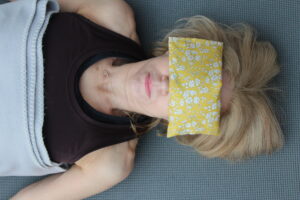
The Mighty Eye Pillow: A Small but Powerful Invitation to Rest (8 min read)
At a recent festival, I spent a great deal of

Last week, I was travelling to Germany for my mum’s 80th birthday.
It is a beautiful milestone, and one that naturally makes you pause. This year also marks 20 years since my dad passed away, and I recently had another birthday myself. Perhaps this is simply what happens as we get older: we begin to look back a little more often, not necessarily with sadness, but with a deeper awareness of the life we have lived so far.
At home, we have also been redecorating. And as anyone who has ever started “just clearing one cupboard” will know, it rarely stays that simple.
One drawer leads to another. One box opens into ten more. Suddenly, you are sitting on the floor surrounded by old photographs, letters, forgotten objects, chargers, cables, keepsakes and memories.
It becomes less about clearing out, and more about taking stock.
Of what you have owned.
What you have carried.
What you have kept.
And what has quietly accompanied you through the different chapters of your life.
An antique cabinet that has travelled through life with me.
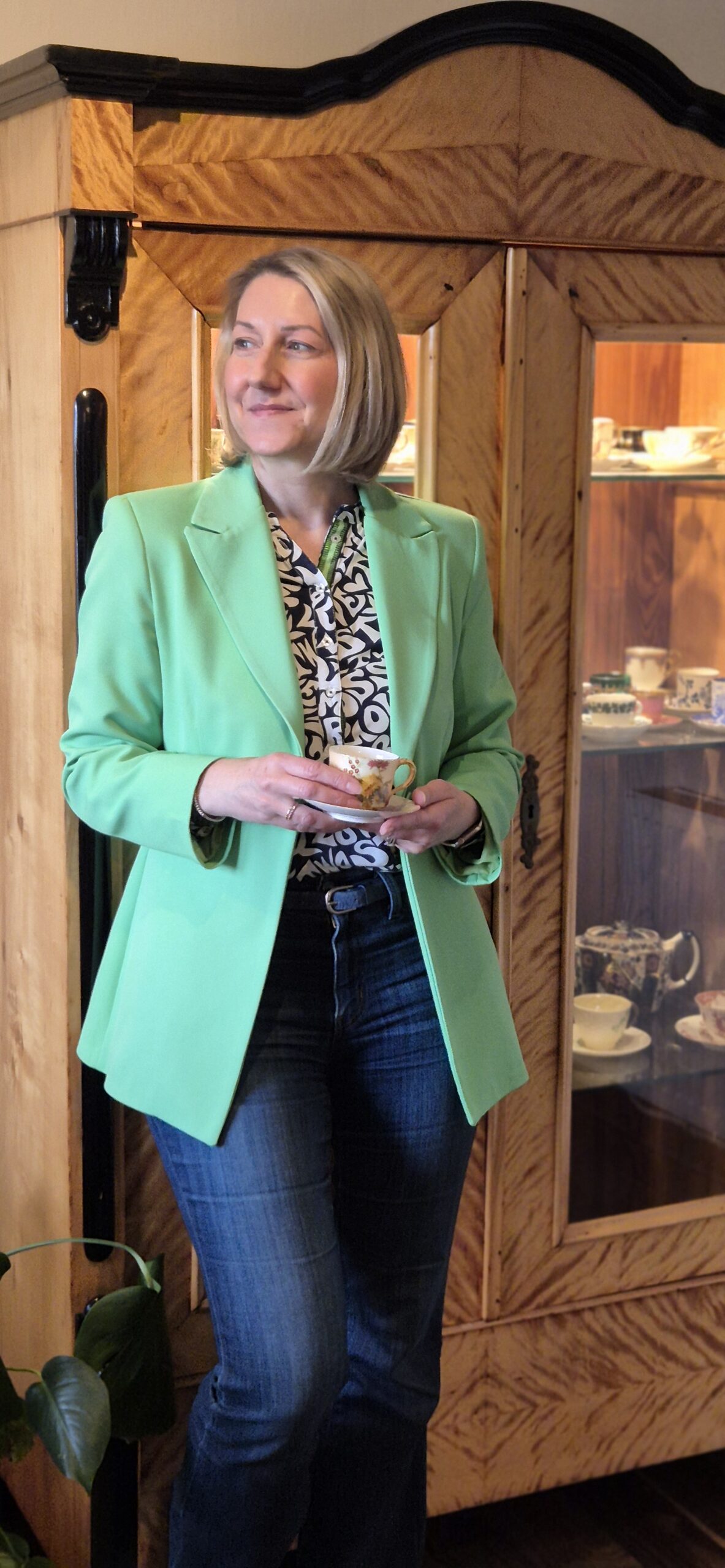
There is an antique Biedermeier Cabinet in our home that I would never part with.
It is not just a piece of furniture. It is one of the first pieces my father ever restored, and it has travelled with me through different stages of my life and across countries. It has stood in different homes, witnessed different versions of me but always held my precious cup collection.
To someone else, it may simply be an old cabinet.
To me, it carries memory.
It reminds me of my father’s hands, his skill, his patience and his eye for quality. It reminds me of the homes I grew up in, the antique markets we visited, and the quiet appreciation for craftsmanship that was part of my childhood long before words like “sustainability” or “circular living” became part of everyday language.
It is not perfect, but that is not the point.
Its value is not only in its age, its wood, or its craftsmanship. Its value is in the story it carries. The fact that it has already lived a life before me, and continues to serve a purpose now.
That, to me, is what makes an object meaningful.
A drawer full of obsolete charging cables and plugs.
And then, during the same clear-out, I opened another drawer.
Inside was a tangled collection of charging cables, plugs and adaptors. Phone chargers, camera cables, old USB leads, connectors for devices we no longer own and ports that no longer fit anything.
Most of them are already obsolete.
It made me think.
We all like progress. Many of us enjoy the latest mobile phone, the better camera, the faster device, the new thing that promises to make life easier, more efficient, more connected.
But so often, the new thing comes with another cable, another charger, another accessory. The old one gets pushed into a drawer “just in case”, until one day we realise that almost none of it is useful anymore.
Some of it may be recycled, of course, and thankfully there is more awareness around electronic waste now than there used to be. But it still says something about the world we live in.
A world where so many things are made to be replaced.
A world where convenience often comes with a hidden cost.
A world where we are encouraged to upgrade, renew, replace and discard almost without thinking.
How strange that so many modern objects are designed to become useless within a few years, while furniture made generations ago can still stand proudly in our homes and fulfil its purpose.
We have become very good at creating convenience. But we have also become very good at creating waste.
What does lasting value really mean?
When I look at that wardrobe, I see something very different from the drawer full of cables.
I see lasting value.
Not because it is fashionable in a trend-led sense. Not because it is new, shiny or perfect. But because it was made with care, restored with skill and kept with love.
There is something deeply grounding about objects that last.
They connect us to people, places and moments. They remind us that quality matters. That repair matters. That materials matter. That not everything needs to be replaced simply because it is old.
In many ways, the objects that stay with us ask something different of us. They ask us to notice. To care. To maintain. To live with a little more patience.
And perhaps that is why antiques, vintage pieces, handmade objects and upcycled materials feel so different from mass-produced things.
They carry traces of human hands.
Someone made them.
Someone chose them.
Someone used them.
Someone kept them.
Someone passed them on.
And when we bring them into our own homes, we become part of that story too.
Awareness days are lovely, but…
May brings with it several awareness days and campaigns that speak to these ideas in different ways.
Mental Health Awareness Week reminds us to look after our minds and create space for rest, connection and perspective. National Walking Month encourages us to slow down and move through the world in a more mindful way. World Bee Day and International Day for Biological Diversity remind us how much we depend on the natural world, and how important even the smallest creatures and ecosystems are.
I love that these days exist.
They remind us to pause.
To notice.
To care.
But part of me also wishes we did not need them as reminders.
Imagine if Earth Day was every day.
If we thought about the bees every day.
If we protected our oceans every day.
If we walked more, wasted less and made small conscious choices every day.
Not perfectly. Not all at once. But consistently.
Because true circular living is not about one day, one campaign or one perfectly curated moment. It is about the quiet choices we make again and again.
What we buy.
What we keep.
What we repair.
What we reuse.
What we pass on.
And what we choose not to waste.
Circular living starts with noticing
For me, circular living is not about trends or guilt.
It is not about doing everything perfectly or never buying anything new. It is about becoming more aware of what already exists. It is about valuing what has lasted. It is about asking whether something can be repaired, repurposed, rehomed or given a new life before we decide it has no value left.
Sometimes that might mean choosing a vintage piece of furniture instead of buying new.
Sometimes it might mean using beautiful fabric remnants to create something useful and meaningful.
Sometimes it might mean buying fewer, quality pieces that are made with care.
Sometimes it might simply mean opening a drawer, seeing what we have accumulated, and thinking a little more carefully about what we bring into our homes next.
This is not about perfection. It is about intention.
And intention matters.
Objects with meaning
Equilibrium Lifestyle grew from this way of thinking.
The idea began with beautiful upholstery fabric remnants that felt far too good to throw away. Materials that had quality, texture and potential, but that no longer had an obvious purpose in their original form.
Rather than seeing them as waste, I saw the beginning of something new.
Meditation cushions.
Eye pillows.
Yoga Mat bags.
Handmade pieces for calmer, more mindful homes.
The same thinking sits behind the antique and vintage pieces I am drawn to. I love objects with character, craftsmanship and story. Pieces that have lived before, and still have so much more life left in them.
To me, that is where beauty and sustainability meet.
Not in buying more for the sake of it, but in choosing more thoughtfully. In surrounding ourselves with pieces that mean something. In creating homes that reflect who we are, what we value and how we want to live.
Because some objects are not just things.
They are part of the story of a life lived.
They remind us where we come from.
They travel with us through change.
They connect us to people we love.
They hold memory, meaning and quiet beauty.
And perhaps, in a world that moves so quickly, these are exactly the kinds of things worth holding on to.
Love,
Nad x
At a recent festival, I spent a great deal of
There is something deeply grounding and connecting about living with

This Christmas, the dash for last-minute stocking fillers is giving
| Cookie | Duration | Description |
|---|---|---|
| cookielawinfo-checkbox-analytics | 11 months | This cookie is set by GDPR Cookie Consent plugin. The cookie is used to store the user consent for the cookies in the category "Analytics". |
| cookielawinfo-checkbox-functional | 11 months | The cookie is set by GDPR cookie consent to record the user consent for the cookies in the category "Functional". |
| cookielawinfo-checkbox-necessary | 11 months | This cookie is set by GDPR Cookie Consent plugin. The cookies is used to store the user consent for the cookies in the category "Necessary". |
| cookielawinfo-checkbox-others | 11 months | This cookie is set by GDPR Cookie Consent plugin. The cookie is used to store the user consent for the cookies in the category "Other. |
| cookielawinfo-checkbox-performance | 11 months | This cookie is set by GDPR Cookie Consent plugin. The cookie is used to store the user consent for the cookies in the category "Performance". |
| viewed_cookie_policy | 11 months | The cookie is set by the GDPR Cookie Consent plugin and is used to store whether or not user has consented to the use of cookies. It does not store any personal data. |